Your Dyno Sheet Is Not a Report Card: The Truth About LS Tuning Numbers
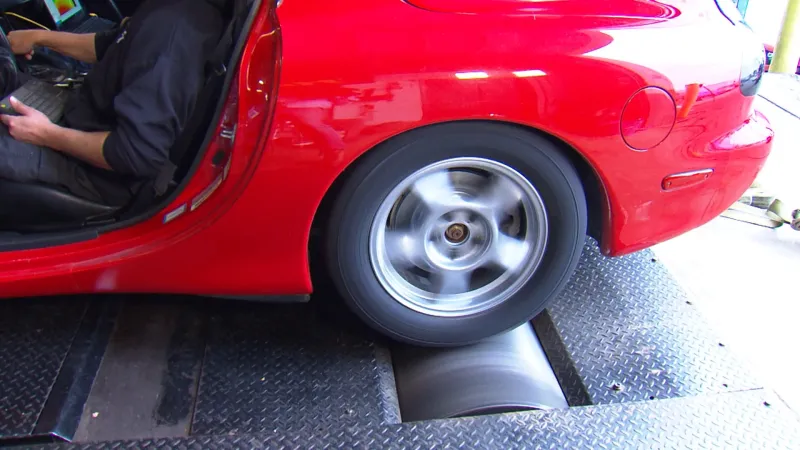
Photo: dyno tuning chassis dynamometer sports car horsepower test, via www.motorweek.org
Let's get something out of the way right up front: that dyno sheet taped to your dash is not proof of anything. Not really. It's a snapshot — a single data point captured under a specific set of conditions on a specific machine, interpreted by a specific tuner, on a specific day. Change any one of those variables and your "520 horsepower" LS might suddenly read 480. Or 560. The number is real, but what it represents is a lot murkier than most builders want to admit.
This isn't a knock on dyno tuning. Dynos are genuinely valuable tools — arguably the most important tool in a tuner's arsenal. But the culture around dyno numbers in the LS community has gotten a little out of hand, and it's leading builders to make bad decisions based on misleading comparisons.
Not All Dynos Are Speaking the Same Language
The most fundamental issue is that different dynamometers produce different results, even when measuring the same engine. The two most common types you'll encounter at shops across the U.S. are inertia dynos (like the Dynojet) and load-bearing dynos (like the Mustang MD-AWD or SuperFlow). They measure power differently, and the gap between them can be significant.
Inertia dynos calculate power by measuring how quickly a known mass (the drum) accelerates. They tend to produce higher peak numbers because they allow the engine to sweep through the RPM range at a relatively fast rate — the engine never really has to sustain that power output. Load-bearing dynos apply actual resistance and force the engine to hold power at a given RPM, which more closely mimics real-world driving conditions. The result? The same engine can read 30–50 horsepower lower on a load-bearing dyno than it does on a Dynojet.
"Guys come in all the time saying their buddy made 480 on a Dynojet and they only made 440 on ours," says one Texas-based LS tuner who's been doing this for over a decade. "I have to explain that those numbers aren't really comparable. It's like measuring in inches versus centimeters and arguing about which one is longer."
The Weather Is Messing With Your Numbers
Dyno facilities correct for atmospheric conditions using a standardization formula — SAE J1349 is the most common one in the U.S. — but correction factors are not magic. They're mathematical estimates, and they carry their own margin of error.
Temperature, humidity, and barometric pressure all affect how dense the air charge is entering your engine. A hot, humid August afternoon in Houston is going to produce meaningfully different results than a cool, dry October morning in Denver — even with correction factors applied. Some shops are meticulous about climate control and use consistent correction standards. Others... aren't.
The practical takeaway: if you're comparing your dyno sheet from a summer session in Georgia against a friend's pull from a winter day in Minnesota, you're not comparing the same thing. Period.
The Tuner Matters More Than the Dyno
Here's the part nobody likes to hear: the biggest variable on a dyno isn't the machine — it's the person operating it and making calibration decisions.
A skilled LS tuner isn't just chasing peak horsepower. They're building a fuel and ignition map that works across the entire operating range — at part throttle, in traffic, under sustained load on a highway pull. That kind of comprehensive calibration takes time, and it often means leaving peak numbers on the table in exchange for a tune that's safe, consistent, and drivable.
A less experienced tuner, or one who's optimizing for impressive printouts rather than real-world performance, can absolutely produce a flashier dyno sheet. They might run more timing than is safe for your fuel, lean out the mixture slightly at peak RPM to inflate the number, or ignore what's happening in the mid-range entirely. The car will make a big number. It will also be more likely to detonate, foul plugs, or grenade a piston six months down the road.
"I'd rather show a customer a 460-horsepower tune that's rock solid across the whole curve than a 510 that's only safe for thirty seconds at WOT on race gas," says a Nashville-based calibrator with more than fifteen years on LS platforms. "Peak numbers win arguments on the internet. They don't win races."
What the Dyno Sheet Should Tell You
Stop looking at just the peak number. Seriously. The most valuable information on a dyno graph is the torque and power curve — the shape of it, not the summit.
A healthy LS tune should show a broad, relatively flat torque curve that builds progressively and doesn't fall off a cliff after peak power. You want to see the air-fuel ratio (AFR) trace if your tuner provides it — ideally in the 12.5:1 to 13.2:1 range at wide-open throttle for a naturally aspirated build, richer for boosted applications. You want to see ignition timing advancing cleanly without signs of knock retard pulling it back.
If your tuner hands you a dyno sheet with just a peak horsepower number and no supporting data, ask questions. A professional calibrator should be able to walk you through the AFR trace, the timing curve, and the knock sensor data. If they can't — or won't — that's a red flag.
Peak vs. Area Under the Curve
This concept trips up a lot of builders: area under the power curve matters more to real-world performance than peak horsepower. An engine that makes 480 horsepower from 4,500 RPM all the way to 6,500 RPM is going to feel dramatically stronger on the street and strip than one that peaks at 510 for a narrow 500-RPM window.
This is especially relevant for LS builds that spend most of their time at partial throttle — street cars, cruisers, anything that isn't a dedicated track weapon. A tune optimized for broad power delivery will make the car faster in almost every real-world scenario, even if the peak number looks less impressive on paper.
So What Should You Actually Care About?
Here's the practical framework:
Before the tune: Establish a baseline pull. Know where you're starting from so you can measure actual gains from changes.
During the tune: Ask your tuner to explain their process. A good LS calibrator will walk you through what they're targeting and why. If the conversation is all about peak numbers, redirect it.
After the tune: Drive the car. Does it pull cleanly from idle? Does it stumble on tip-in? Does it feel crisp at part throttle in traffic? A dyno tune that doesn't translate to a better driving experience is a failed tune, regardless of the number at the top of the graph.
Comparing to others: Just don't. Unless you're on the same dyno, in the same conditions, with the same correction standard, the comparison is meaningless.
The dyno is a tool for the tuner, not a scoreboard for you. Use it that way, and you'll get a lot more out of your LS build than a number to brag about at the next car show.