Perfect on the Dyno, Dead on the Street: What's Really Killing Your LS Build's Drivability
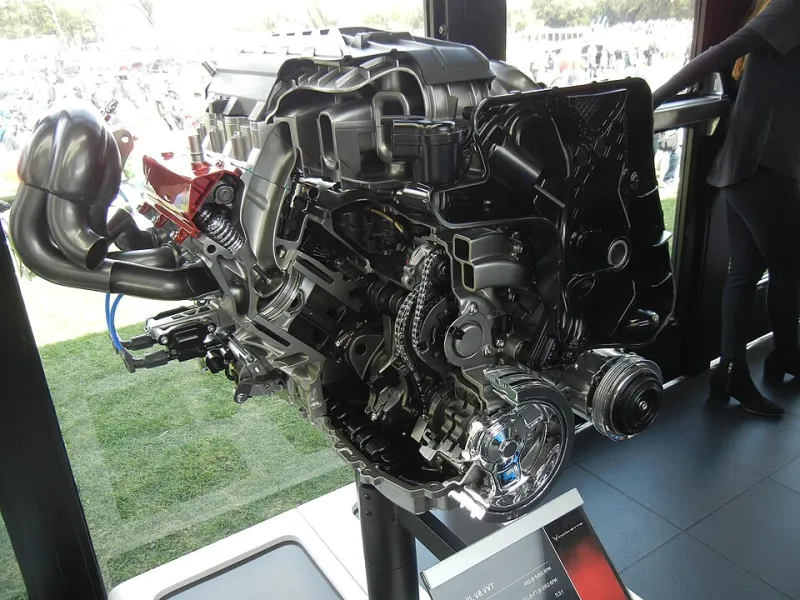
Photo: MN, CC BY-SA 4.0, via Wikimedia Commons
There's a special kind of frustration reserved for the builder who straps their LS swap to the rollers, watches the numbers climb, and drives home feeling like a genius — only to have the thing stumble, surge, or just flat-out die at the worst possible moment two weeks later. It happens more than anyone in this hobby wants to admit, and it's not always because the tune is bad or the parts are wrong. Sometimes it's because a dyno, for all its usefulness, is basically a lie detector that only tests one very specific kind of honesty.
Let's dig into why that gap exists and what you can actually do about it.
The Dyno Is a Controlled Environment — Your Commute Is Not
A chassis dyno is a remarkable tool, but it operates under conditions that almost never exist in the real world. The shop is temperature-controlled, the air is relatively consistent, and most pulls are done at wide-open throttle under steady-state load. Your tuner optimizes for those conditions because that's what the equipment measures well.
Now think about what your LS actually faces on a Tuesday afternoon in Phoenix in August. The intake air temperature is 115 degrees. You've been sitting in stop-and-go traffic for 20 minutes. The engine bay is heat-soaked, the fuel pressure has been cycling up and down, and you're asking the engine to respond instantly to a 30 percent throttle input at 1,800 RPM. That scenario never appeared in the dyno session. Not once.
The tune that made 480 wheel horsepower in a 68-degree shop might be completely unprepared for those conditions — not because the tuner did anything wrong, but because the dyno simply can't replicate every variable your engine will encounter across 50,000 miles of real driving.
Part-Throttle Tuning Is Where Most Builds Fall Apart
Wide-open throttle is relatively easy to tune. You're looking at a narrow band of inputs, and the engine responds predictably. Part-throttle operation — the stuff you actually use 95 percent of the time — is a completely different animal.
Idle to light cruise transitions, tip-in response, deceleration fuel cut, torque management under light load — all of this lives in the part-throttle tables of your ECU calibration, and it's the area that gets the least attention during a typical dyno session. Tuners who are under time pressure will nail the WOT pulls, make sure the idle is stable, and send you on your way. What you end up with is a tune that's optimized for the extremes but rough through the middle.
Symptoms include a hesitation when you first crack the throttle from a stop, a surge at steady highway speeds, and that annoying lean stumble when you lift off the gas and then reapply. None of these show up on a power graph. They only show up when you're actually driving the car.
Sensor Calibration Errors That Only Matter in Motion
Here's a subtle one that catches a lot of swappers off guard: your sensors might be technically functional but incorrectly calibrated for your specific setup, and the dyno will never catch it.
The MAP sensor is a common culprit. If you're running a non-stock intake manifold or a forced induction setup and the MAP calibration isn't dialed in for your actual boost or vacuum curve, the ECU is making fueling and timing decisions based on bad data. At WOT on the dyno, this might only cause a minor deviation. On the street, where the engine is constantly hunting through different load points, that bad data compounds into a drivability nightmare.
The same goes for your coolant temperature sensor if you've relocated it from the factory position, your IAT sensor if it's mounted somewhere that doesn't reflect actual charge air temperature, and your throttle position sensor if the sweep isn't calibrated to match your actual pedal travel. Each of these is a small error. Stacked together, they create an engine that feels confused — because it is.
Heat Soak: The Enemy That Doesn't Exist in a Shop
If you've done an LS swap into a tighter engine bay — a first-gen Camaro, a classic truck, an S10, anything with limited airflow — heat soak is probably responsible for at least some of your street woes. The dyno pull takes maybe 10-15 seconds. Your engine never gets a chance to fully heat-soak during that window.
On the street, after 45 minutes of mixed driving, the intake manifold is absorbing radiant heat from the exhaust, the headers are glowing, and the fuel rails are cooking. Fuel vaporizes in the lines, the IAT climbs 40 or 50 degrees above ambient, and suddenly the tune that worked perfectly in a cool shop is running the engine lean under conditions it was never optimized for.
The fix here is partly mechanical — better heat shielding, improved underhood airflow, insulated fuel lines — and partly tuning. Your calibration needs to account for elevated IAT readings with appropriate fuel and timing corrections. If those correction tables are flat or shallow, you're going to feel it every time the car gets hot.
Road Load vs. Dyno Load: They're Not the Same Thing
A chassis dyno measures the power your wheels put into the rollers. What it can't fully replicate is the actual inertia of a 3,500-pound vehicle accelerating through traffic, or the sustained load of climbing a long grade at 70 MPH, or the specific harmonic resonance your drivetrain develops at 2,200 RPM in fourth gear on a rough interstate.
Some drivability issues are pure resonance problems — the engine and drivetrain finding a frequency at a specific RPM and load combination that causes a vibration or stumble. You'll feel it at the same spot every single time, but it only exists at that precise combination of speed, gear, and throttle position. The dyno will never find it because you're never in that exact state on the rollers.
The Fix: Street Tuning Has to Be Part of the Process
The solution isn't to abandon the dyno — it's a genuinely useful tool for dialing in WOT calibration and verifying peak output. But a dyno session alone is not a complete tune. Any serious LS calibrator will tell you that street tuning, or at minimum extended road load tuning on a load-bearing dyno, is essential for a car you plan to actually drive.
If your tuner hands you the keys after a few WOT pulls and calls it done, ask specifically about part-throttle tables, IAT compensation curves, and decel fuel behavior. Ask whether they've addressed the conditions your car will actually face. A good tuner won't be offended by those questions. They'll probably appreciate that you're paying attention.
Log your data on the street. Wideband O2 readings, IAT, MAP, and coolant temp at a minimum. Bring that data back to your tuner and let them see what the engine is actually experiencing. That feedback loop — dyno baseline, street data, refinement — is how you get a build that's as fast in traffic as it is on the rollers.
The dyno is the starting line, not the finish line. Your street tune is where the real work gets done.